What to Expect From a Liver Cancer Blood Test: From Blood Collection to Results
Blog What to Expect From a Liver Cancer Blood Test: From Blood…
Most people at high risk for liver cancer already know they should be screened. They have cirrhosis, hepatitis B or C, or fatty liver disease. Their physician has mentioned monitoring. They understand the stakes.
And yet — they do not get screened.
Not because they do not care. Because getting screened means scheduling a clinic appointment, arranging transport, taking time off work, sitting in a waiting room, and doing it all over again every few months. For patients managing a chronic liver condition, that barrier is real. For many, it becomes the reason surveillance never happens consistently.
Liver cancer screening at home changes that. For eligible high-risk patients, MoleculeDx brings the sample collection process to you — so the barrier between knowing you need screening and actually getting it done becomes significantly smaller.
Yes — and this is one of the most important advances in HCC surveillance accessibility in recent years.
Traditional liver cancer screening has required a clinic visit for blood draw, followed by a separate imaging appointment for ultrasound. For patients with mobility limitations, demanding work schedules, or limited access to specialist centres, this two-step process creates consistent friction that leads to missed surveillance windows.
Liver cancer screening at home removes the clinic visit from the equation for the blood collection step. Through MoleculeDx, eligible patients can have a certified phlebotomist come directly to their home, collect the blood sample on site, and have results returned within 24 hours — without leaving the house.
This is not a self-collection kit. The sample is drawn by a trained, certified phlebotomist in your home, ensuring the same clinical standard as an in-clinic draw. The difference is location — not quality.
The process is straightforward and designed around the patient’s schedule, not the clinic’s.
Step 1 — Check eligibility and book Visit moleculedx.com/for-patients/ to confirm that at-home collection is available in your location and that you meet the eligibility criteria for MoleculeDx testing.
Step 2 — A certified phlebotomist visits your home MoleculeDx coordinates at-home blood collection through Portamedic and Travalab — two established, certified phlebotomy service providers operating across all 50 US states. A trained professional comes to your home at a scheduled time, draws the blood sample, and handles all packaging and transport.
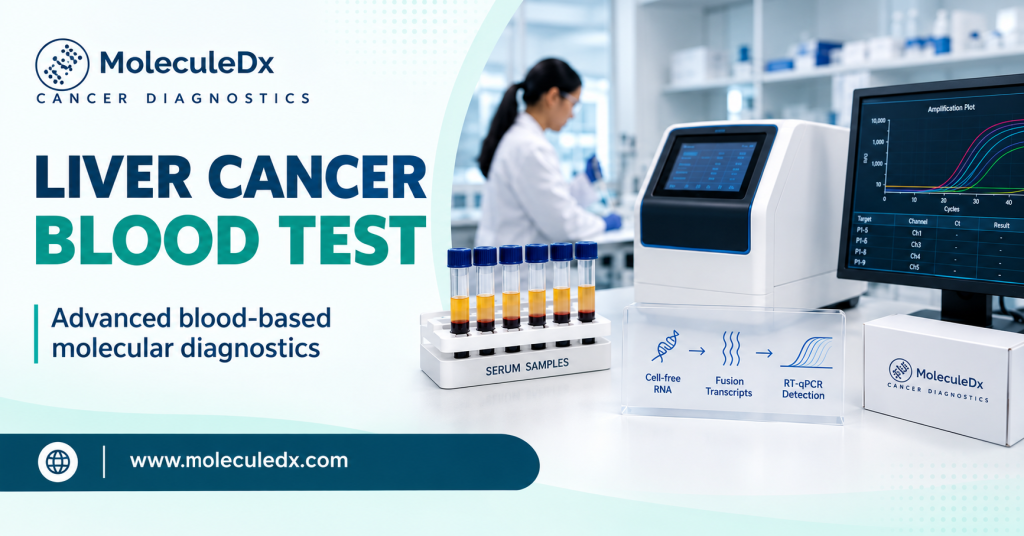
Step 3 — Sample is processed Your sample is transported to the MoleculeDx laboratory, where the Fusion-detect™ test analyses nine specific RNA fusion transcripts — molecular markers released into the bloodstream by liver cancer cells. A machine-learning algorithm processes the markers and generates your result.
Step 4 — Results returned within 24 hours Results are returned within 24 hours of sample receipt. You receive your result and are guided to share it with your physician for review and any necessary follow-up.
Alternatively, if you prefer an in-person draw or are located near a UPMC facility, walk-in collection is available at all UPMC locations across the country.

At-home liver cancer screening through MoleculeDx is designed for high-risk patients — people whose underlying liver conditions place them at elevated risk for hepatocellular carcinoma.
Common risk factors that may make you eligible include:
If you have one or more of these conditions and are not currently enrolled in a regular liver cancer surveillance programme, checking your eligibility for at-home testing is a practical first step. The American Association for the Study of Liver Diseases recommends regular HCC surveillance for patients with cirrhosis — at-home collection makes maintaining that cadence significantly more manageable.
Once your blood sample has been collected and transported to the MoleculeDx laboratory, the Fusion-detect™ test gets to work. The test was developed from research funded by the National Cancer Institute at the University of Pittsburgh School of Medicine and achieved up to 95 percent accuracy in detecting HCC in NCI-supported research — including in patients with completely normal AFP values.
Your result will indicate either low risk or elevated risk for hepatocellular carcinoma.
A low-risk result provides useful information for your ongoing surveillance conversation with your physician. It does not remove the need for continued monitoring if your underlying risk factors remain present.
An elevated-risk result is not a diagnosis. It is a clinical signal that your physician will typically follow up with contrast-enhanced CT or MRI imaging to investigate further. HCC identified at this stage — before symptoms appear — is significantly more treatable than cancer found after the disease has progressed.
In both cases, your result should be reviewed with a qualified healthcare provider as part of a broader surveillance plan. MoleculeDx is a screening support tool — healthcare providers remain central to interpreting results and guiding next steps.
Results from the Fusion-detect™ liver cancer blood test are returned within 24 hours of sample receipt at the laboratory. This turnaround is one of the most significant practical advantages of the test — patients and their physicians receive actionable information quickly, without the delays that can accompany traditional imaging-based surveillance.
The $160 at-home collection price includes phlebotomist visit coordination, sample transport, laboratory processing, and result delivery.
Do I need to visit a clinic for liver cancer screening at home? No. Through MoleculeDx, a certified phlebotomist comes to your home to collect the blood sample. You do not need to visit a clinic, laboratory, or imaging centre for the collection step. Walk-in collection at UPMC locations is also available if preferred.
Is liver cancer screening at home available in my location? At-home collection through MoleculeDx is available across all 50 US states via Portamedic and Travalab. Check availability for your specific location at moleculedx.com/for-patients/ when booking.
Do I need a physician order to book the test? Check the eligibility and booking process at moleculedx.com/for-patients/ for the most current requirements. Results are designed to be shared with and reviewed by your physician as part of an ongoing surveillance plan.
What happens if my result needs follow-up? An elevated result from any liver cancer screening test is not a diagnosis. It indicates that closer clinical investigation is warranted. Your physician will typically recommend contrast-enhanced CT or MRI imaging as the next step. Early-stage HCC identified through this pathway is significantly more treatable than cancer discovered after symptoms develop.
If you are at high risk for liver cancer and have been putting off screening because getting to a clinic feels like too much — that barrier just got smaller.
Start by checking whether MoleculeDx testing and at-home sample collection are available for your location
connect with us : facebook , Instagram
Blog What to Expect From a Liver Cancer Blood Test: From Blood…

Blog Liver Cancer Blood Markers: What Do They Tell Us? Blood tests…
Blog 5 Benefits of Regular Liver Cancer Surveillance for People at High…