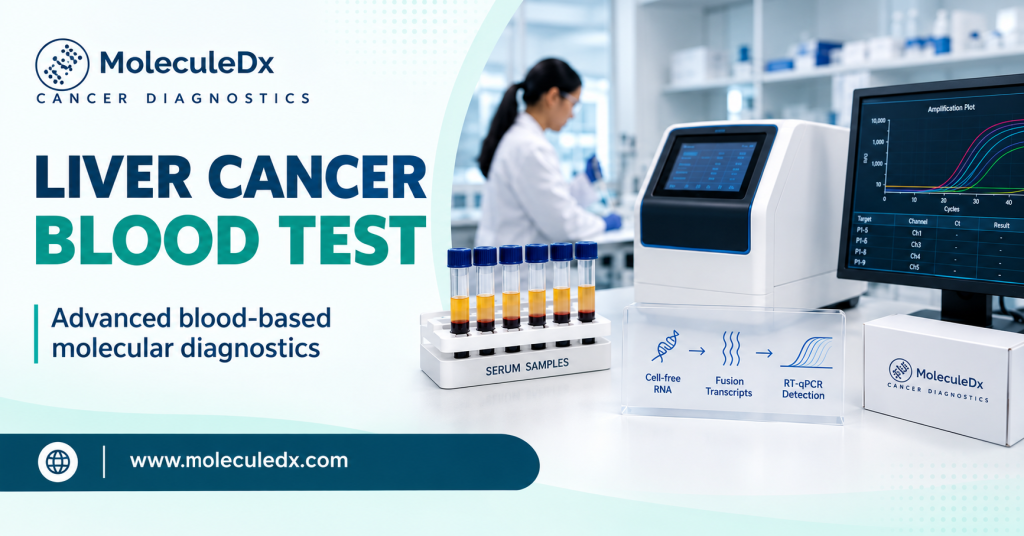
The challenge is not a lack of will. It is a lack of accurate tools. One of the biggest problems is our continued reliance on alpha‑fetoprotein (AFP) testing—a marker that has been used for decades despite one critical flaw: it misses liver cancer in nearly half of the patients who have it.
What Is AFP Testing?
Alpha‑fetoprotein (AFP) is a protein produced by the liver. Elevated AFP levels in the blood can suggest the presence of hepatocellular carcinoma (HCC), the most common form of primary liver cancer.
Because of this, AFP has been used as a primary screening and surveillance marker for HCC since the 1970s. For high‑risk patients—those with hepatitis B, hepatitis C, cirrhosis or non‑alcoholic fatty liver disease—AFP testing is often part of routine follow‑up, typically performed every six months alongside ultrasound imaging.
On paper, this combination looks reasonable. In practice, the numbers tell a very different story.
The Critical Limitation of AFP
AFP testing for liver cancer has an overall accuracy of only about 50–60%, depending on the cut‑off and population studied. In other words, up to 40–50% of liver cancer cases may not be detected by AFP testing alone.
The reason is straightforward but troubling: many liver cancer patients never develop elevated AFP levels, even when a tumour is present and growing. Studies show that roughly 15–30% of HCC patients have completely normal AFP values throughout the course of their disease.
When a test designed to detect cancer shows “normal” in a patient who actually has cancer, the consequences are severe:
- Detection is delayed
- Treatment options narrow
- Survival rates decline
What Happens When Liver Cancer Is Missed?
Early‑stage liver cancer (Stage I–II) is often highly treatable. When detected early, surgical resection, ablation or liver transplantation can deliver long‑term survival rates in the range of 60–90%, depending on tumour stage, liver function and patient selection.
Late‑stage liver cancer is a very different story. Once the disease progresses to Stage III or IV, median survival can fall to under 12 months, even with aggressive therapy. The window between an undetected early tumour and a late‑stage diagnosis is exactly the window that AFP‑based screening is supposed to close—yet its 50–60% accuracy means that window is left open far too often.
A National Cancer Institute–Confirmed Alternative
In July 2024, the National Cancer Institute (NCI) highlighted findings that confirm a major advance in liver cancer screening accuracy. Researchers funded by NCI’s Division of Cancer Biology, led by Dr. Jian‑Hua Luo at the University of Pittsburgh School of Medicine, developed a machine‑learning model based on serum fusion transcripts and achieved up to 95% accuracy in detecting HCC.
This approach did more than outperform AFP:
- It detected liver cancer with dramatically higher accuracy
- It identified HCC in patients with completely normal AFP levels
- It tracked treatment response and helped predict cancer recurrence using a single blood draw
The MoleculeDx Fusion HCC Predictor is built directly on this body of science.
What Are Fusion Transcripts?
Fusion transcripts are abnormal RNA molecules created when chromosomal rearrangements occur in cancer cells. These events are highly specific to malignancy—healthy cells do not produce the same fusion patterns.
When liver cancer develops, tumour cells shed these fusion transcripts into the bloodstream. The MoleculeDx test detects a defined panel of nine fusion transcripts—such as MAN2A1‑FER, PTEN‑NOLC1 and SLC45A2‑AMACR—that act as highly specific molecular markers for HCC.
A machine‑learning algorithm then integrates the presence and pattern of these markers to generate a high‑ or low‑risk prediction. The result is a test that can work even when AFP is completely normal, because it is reading a different and deeper biological signal.
Why AFP Alone Is No Longer Enough
AFP testing has served an important role in liver cancer care for more than fifty years. But in the era of multi‑signal, blood‑based diagnostics, a tool that misses up to half of cancers can no longer be considered sufficient.
A serum fusion transcript model with up to 95% accuracy has now been demonstrated in peer‑reviewed research and highlighted by the National Cancer Institute. AFP’s 50–60% performance is no longer acceptable when such an alternative exists.
- The National Cancer Institute has confirmed the potential of serum fusion‑gene models
- The American Journal of Pathology and related journals have published the data
- MoleculeDx has translated this science into a clinical‑grade test
What This Means for Physicians and Patients
If you are a physician caring for high‑risk patients—or a patient living with hepatitis, cirrhosis or a family history of liver cancer—the question is no longer whether to be screened. Early detection remains critical to survival.
The real question is how you are screened—and whether you are relying on tools that miss a substantial fraction of cancers.
When a more accurate, biology‑driven alternative is available, the decision becomes clear:
Choose screening built on the strongest data possible.
To learn more about the Fusion HCC Predictor and multi‑signal liver cancer detection, visit moleculedx.com
Every year, more than 700,000 people die from liver cancer worldwide. A significant portion of those deaths could be prevented if the cancer were detected earlier, when treatment options are broader and outcomes are better.
The challenge is not a lack of will. It is a lack of accurate tools. One of the biggest problems is our continued reliance on alpha‑fetoprotein (AFP) testing—a marker that has been used for decades despite one critical flaw: it misses liver cancer in nearly half of the patients who have it.
What Is AFP Testing?
Alpha‑fetoprotein (AFP) is a protein produced by the liver. Elevated AFP levels in the blood can suggest the presence of hepatocellular carcinoma (HCC), the most common form of primary liver cancer.
Because of this, AFP has been used as a primary screening and surveillance marker for HCC since the 1970s. For high‑risk patients—those with hepatitis B, hepatitis C, cirrhosis or non‑alcoholic fatty liver disease—AFP testing is often part of routine follow‑up, typically performed every six months alongside ultrasound imaging.
On paper, this combination looks reasonable. In practice, the numbers tell a very different story.
The Critical Limitation of AFP
AFP testing for liver cancer has an overall accuracy of only about 50–60%, depending on the cut‑off and population studied. In other words, up to 40–50% of liver cancer cases may not be detected by AFP testing alone.
The reason is straightforward but troubling: many liver cancer patients never develop elevated AFP levels, even when a tumour is present and growing. Studies show that roughly 15–30% of HCC patients have completely normal AFP values throughout the course of their disease.
When a test designed to detect cancer shows “normal” in a patient who actually has cancer, the consequences are severe:
- Detection is delayed
- Treatment options narrow
- Survival rates decline
What Happens When Liver Cancer Is Missed?
Early‑stage liver cancer (Stage I–II) is often highly treatable. When detected early, surgical resection, ablation or liver transplantation can deliver long‑term survival rates in the range of 60–90%, depending on tumour stage, liver function and patient selection.
Late‑stage liver cancer is a very different story. Once the disease progresses to Stage III or IV, median survival can fall to under 12 months, even with aggressive therapy. The window between an undetected early tumour and a late‑stage diagnosis is exactly the window that AFP‑based screening is supposed to close—yet its 50–60% accuracy means that window is left open far too often.10]
A National Cancer Institute–Confirmed Alternative
In July 2024, the National Cancer Institute (NCI) highlighted findings that confirm a major advance in liver cancer screening accuracy. Researchers funded by NCI’s Division of Cancer Biology, led by Dr. Jian‑Hua Luo at the University of Pittsburgh School of Medicine, developed a machine‑learning model based on serum fusion transcripts and achieved up to 95% accuracy in detecting HCC.
This approach did more than outperform AFP:
- It detected liver cancer with dramatically higher accuracy
- It identified HCC in patients with completely normal AFP levels
- It tracked treatment response and helped predict cancer recurrence using a single blood draw
The MoleculeDx Fusion HCC Predictor is built directly on this body of science.
What Are Fusion Transcripts?
Fusion transcripts are abnormal RNA molecules created when chromosomal rearrangements occur in cancer cells. These events are highly specific to malignancy—healthy cells do not produce the same fusion patterns.
When liver cancer develops, tumour cells shed these fusion transcripts into the bloodstream. The MoleculeDx test detects a defined panel of nine fusion transcripts—such as MAN2A1‑FER, PTEN‑NOLC1 and SLC45A2‑AMACR—that act as highly specific molecular markers for HCC.
A machine‑learning algorithm then integrates the presence and pattern of these markers to generate a high‑ or low‑risk prediction. The result is a test that can work even when AFP is completely normal, because it is reading a different and deeper biological signal.
Why AFP Alone Is No Longer Enough
AFP testing has served an important role in liver cancer care for more than fifty years. But in the era of multi‑signal, blood‑based diagnostics, a tool that misses up to half of cancers can no longer be considered sufficient.
A serum fusion transcript model with up to 95% accuracy has now been demonstrated in peer‑reviewed research and highlighted by the National Cancer Institute. AFP’s 50–60% performance is no longer acceptable when such an alternative exists.
- The National Cancer Institute has confirmed the potential of serum fusion‑gene models
- The American Journal of Pathology and related journals have published the data
- MoleculeDx has translated this science into a clinical‑grade test
What This Means for Physicians and Patients
If you are a physician caring for high‑risk patients—or a patient living with hepatitis, cirrhosis or a family history of liver cancer—the question is no longer whether to be screened. Early detection remains critical to survival.
The real question is how you are screened—and whether you are relying on tools that miss a substantial fraction of cancers.
When a more accurate, biology‑driven alternative is available, the decision becomes clear:
Choose screening built on the strongest data possible.
To learn more about the Fusion HCC Predictor and multi‑signal liver cancer detection, visit moleculedx.com.
connect with us : Facebook , Instagram