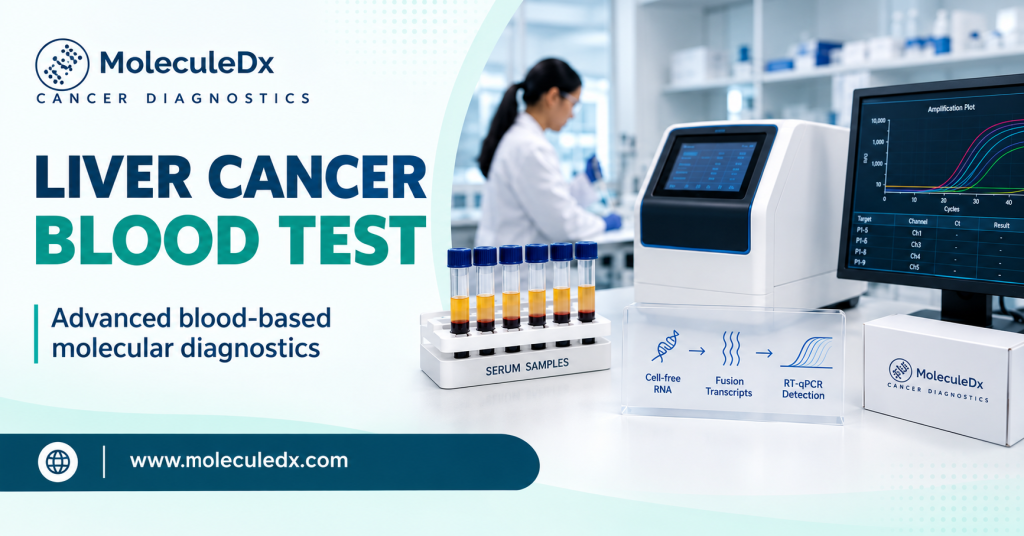
An HCC screening test is used to help monitor people who may be at increased risk of hepatocellular carcinoma — the most common form of primary liver cancer. MoleculeDx provides blood-based testing support for eligible patients as part of a physician-guided screening and follow-up conversation.
What Is HCC?
Hepatocellular carcinoma (HCC) is the most common type of primary liver cancer, accounting for 75 to 85 percent of all primary liver cancer diagnoses. In the United States, over 41,000 new liver cancer cases are diagnosed each year, the majority being HCC.
What makes HCC particularly dangerous is its silent progression. In early stages it produces few or no symptoms. By the time symptoms appear — abdominal pain, unexplained weight loss, or jaundice — the disease has often advanced beyond the point where curative treatment is possible.
When HCC is detected at Stage I or Stage II, long-term survival rates can reach up to 90 percent. At Stage III or IV, median survival drops to under 12 months. Early detection through regular HCC screening is the single most important factor in improving outcomes.
Who Should Discuss HCC Screening?
HCC develops almost exclusively in people with underlying liver conditions. If you have any of the following, speak with your physician about HCC surveillance:
Liver cirrhosis — the leading risk factor for HCC regardless of cause
Chronic hepatitis B infection — the most common cause of HCC globally
Chronic hepatitis C infection — a leading driver of liver cancer in the US specifically
Non-alcoholic fatty liver disease (NAFLD) or NASH — a rapidly growing HCC risk factor tied to obesity and diabetes
Heavy alcohol use causing alcoholic liver disease
Type 2 diabetes combined with liver disease
Family history of liver cancer
For most high-risk patients, current clinical guidelines recommend HCC surveillance every six months.
Common HCC Screening Approaches
Ultrasound imaging is the most widely recommended surveillance tool for high-risk patients. It is non-invasive and widely available, but its sensitivity for detecting early-stage HCC in real-world settings ranges from only 45 to 65 percent — and is further reduced in patients with obesity or advanced cirrhosis.
AFP testing measures alpha-fetoprotein, a protein the liver produces that can be elevated in HCC. AFP has been used as a liver cancer marker since the 1970s. However, it detects HCC in only 50 to 60 percent of cases. Studies show 15 to 30 percent of HCC patients have completely normal AFP values throughout their disease. AFP alone is no longer recommended as a standalone screening tool by major liver disease guidelines.
AFP combined with ultrasound every six months is what most guidelines currently recommend for high-risk patients. This combined approach improves detection but still carries the limitations of both methods.
Blood-based molecular testing represents the next generation of HCC screening. These tests analyze cancer-specific molecular markers in the blood — such as circulating RNA fusion transcripts — that are distinct from AFP. They can detect HCC in patients with normal AFP values, precisely the group standard testing fails most often.
How MoleculeDx Supports HCC Screening
MoleculeDx offers Fusion-detect, a blood-based HCC screening test built on research funded by the National Cancer Institute and conducted at the University of Pittsburgh School of Medicine.
The test identifies nine specific fusion transcripts — abnormal RNA molecules produced by liver cancer cells — using a machine-learning algorithm. In NCI-supported research published in the American Journal of Pathology, this approach achieved up to 95 percent accuracy in detecting hepatocellular carcinoma, including in patients with completely normal AFP levels.
What to know about MoleculeDx Fusion-detect™:
95% accuracy for HCC detection
Detects HCC in patients AFP testing misses
Results within 24 hours
At-home sample collection or walk-in at any UPMC location
Available across all 50 US states
$160 for at-home collection
MoleculeDx testing is designed to support physician-led screening conversations. Results should be shared with your healthcare provider as part of an ongoing surveillance plan.
What Happens After a Screening Result?
Every result — whether low-risk or elevated-risk — should be discussed with your physician.
A low-risk result is useful information for your ongoing surveillance plan but does not remove the need for continued monitoring if you remain in a high-risk category.
An elevated-risk result is not a diagnosis. It is a signal your physician will likely follow up with contrast-enhanced CT or MRI imaging. HCC identified through this pathway at an early stage is significantly more treatable than cancer discovered after symptoms develop.
Frequently Asked Questions
What does HCC stand for? HCC stands for hepatocellular carcinoma — the most common type of primary liver cancer, originating in the liver’s main cells (hepatocytes).
Who needs HCC screening? Anyone with liver cirrhosis, chronic hepatitis B or C, NAFLD progressing to NASH, alcoholic liver disease, or type 2 diabetes with liver involvement should discuss HCC screening with their physician.
Is AFP enough for HCC screening? No. AFP misses liver cancer in up to 40 to 50 percent of cases. Major guidelines no longer recommend AFP as a standalone tool. Blood-based molecular tests like Fusion-detect™ can detect HCC in patients with normal AFP values.
Can MoleculeDx diagnose liver cancer? No. Fusion-detect™ is a screening test, not a diagnostic tool. A diagnosis requires physician assessment, imaging, and in some cases biopsy. Results should always be interpreted by a qualified healthcare provider.
Check Your Eligibility
If you are at high risk for HCC due to cirrhosis, hepatitis, fatty liver disease, or another liver condition, regular monitoring can be life-saving.
Check your eligibility and book the MoleculeDx Fusion-detect test at moleculedx.com/for-patients/ — and discuss your results with a qualified healthcare professional.