Who Should Get HCC Screening?
People with certain liver disease risk factors should discuss hepatocellular carcinoma (HCC) screening with a healthcare professional. This often includes patients with cirrhosis, hepatitis B or C, NAFLD/NASH, alcohol‑related liver disease, or a family history of liver cancer. If you fall into one of these groups, understanding when and how to screen can help catch liver cancer at a more treatable stage.
What is HCC screening?
HCC screening (also called surveillance) is a regular schedule of tests designed to look for liver cancer before symptoms appear. In most current guidelines, this usually means an abdominal ultrasound every six months, with or without a blood test called alpha‑fetoprotein (AFP).
Because more than 80% of HCC cases develop in people with advanced fibrosis or cirrhosis, screening focuses on people at high risk rather than the general population. The goal is to find small tumors or early warning signs when treatment options and chances for long‑term survival are better.
High‑risk groups
You should consider asking about HCC screening if you fall into one of these higher‑risk categories. Your doctor will confirm based on your full history and current guidelines.
1. Cirrhosis from any cause
Most expert guidelines recommend HCC screening for all patients with cirrhosis, regardless of whether the cause is viral hepatitis, alcohol, NAFLD/NASH, or another chronic liver disease. Cirrhosis is the strongest single risk factor for HCC in most populations.
2. Chronic hepatitis B virus (HBV)
People with chronic hepatitis B can develop HCC even without cirrhosis, especially if they are older, male, or from higher‑risk regions such as parts of Asia or Africa. Many guidelines advise surveillance in hepatitis B patients who meet specific age, sex, ethnicity, viral, or family‑history criteria.
3. Chronic hepatitis C virus (HCV)
Patients with hepatitis C and cirrhosis have a significantly increased risk of HCC and are strong candidates for ongoing screening, even after successful antiviral treatment. The risk does not completely disappear after cure, which is why surveillance usually continues in cirrhotic HCV patients.
4. NAFLD or NASH with advanced fibrosis
Non‑alcoholic fatty liver disease (NAFLD) and its more severe form, non‑alcoholic steatohepatitis (NASH), are now leading causes of chronic liver disease and can progress to cirrhosis and HCC. Patients with advanced fibrosis (often stage F3 or higher) or cirrhosis due to NAFLD/NASH are increasingly recognized as needing HCC surveillance.
5. Alcohol‑related liver disease
Long‑term heavy alcohol use can lead to cirrhosis and significantly raise HCC risk. People with alcohol‑related cirrhosis are typically advised to follow the same six‑monthly screening schedule as other cirrhotic patients.
6. Family history and special situations
A first‑degree relative with HCC, certain genetic or metabolic liver conditions, or a combination of risk factors (such as diabetes and obesity on top of fatty liver disease) may further increase your risk. In these cases, your physician may recommend screening even if you do not yet have clearly established cirrhosis.
Because risk can vary from person to person, the best first step is a conversation with a hepatologist, gastroenterologist, or experienced primary care clinician.
Why screening should happen before symptoms
One of the challenges with liver cancer is that early‑stage HCC often causes no symptoms. By the time noticeable signs such as pain, weight loss, jaundice, or fluid buildup appear, the cancer may already be at a more advanced stage.
Studies show that regular surveillance in high‑risk patients can detect HCC earlier and significantly improve the chance of curative treatment and long‑term survival. In some analyses, surveillance has reduced liver‑cancer‑related mortality by more than one‑third compared with no monitoring.
Screening before symptoms is therefore not about looking for trouble; it is about giving you and your care team time and options if something is found.
What screening options exist?
Today, most major guidelines focus on imaging and AFP for HCC surveillance in high‑risk patients.
Abdominal ultrasound
Abdominal ultrasound every six months is the backbone of most HCC surveillance programs and is recommended for all patients with cirrhosis in many liver society guidelines. It is non‑invasive and widely available but can miss small or hard‑to‑visualize lesions, especially in patients with obesity or a very nodular liver.
AFP (alpha‑fetoprotein) blood test
AFP is an older tumor marker that is still used alongside ultrasound in many practices. While it is inexpensive and familiar, AFP alone has limited sensitivity—often only around 50–60%—and may be normal even when cancer is present.
CT or MRI
When ultrasound or blood tests suggest something abnormal, contrast‑enhanced CT or MRI are usually used to confirm or rule out HCC. These scans provide more detail but are more costly and involve radiation (CT) or contrast agents (CT and MRI).
Emerging blood‑based tools
New blood tests are being developed that use multi‑marker panels, genomic or transcriptomic signals, and machine‑learning models to improve early detection beyond AFP alone. MoleculeDx’s Fusion HCC Predictor is an example of this emerging category.
Your care team may combine several of these tools, depending on your underlying liver disease, local resources, and evolving guidelines.
How MoleculeDx may help
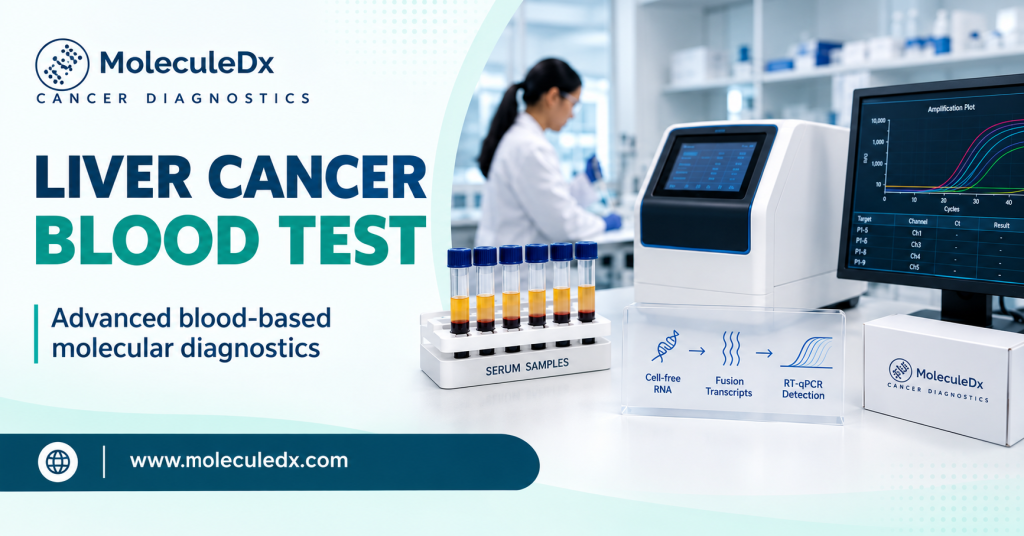
MoleculeDx’s Fusion HCC Predictor is a blood‑based screening tool designed for people at increased risk of HCC, especially those with cirrhosis or chronic viral hepatitis. Rather than relying on a single protein, it analyzes a panel of serum fusion transcripts—abnormal RNA molecules that act as molecular fingerprints of liver cancer—together with AFP using machine‑learning models.
In published research, a nine‑fusion‑transcript panel combined with AI has achieved up to 95% accuracy for predicting HCC in studied cohorts, significantly outperforming AFP alone. This approach has been validated in collaboration with the National Cancer Institute, highlighting its potential to improve early detection in high‑risk populations.
For eligible patients, the Fusion HCC Predictor may complement standard imaging‑based surveillance by offering:
A simple blood draw instead of an imaging‑only strategy
Multi‑signal molecular insight, even when AFP is normal
A clear, risk‑stratified report that can guide follow‑up imaging and clinical decisions
You should always review whether, when, and how to use this kind of test together with your treating physician.
How to take the next step
If you recognize yourself in any of the high‑risk groups above, consider these steps:
Talk with your clinician
Ask whether you meet guideline criteria for HCC screening and what schedule (for example, ultrasound every six months) they recommend.
Review your full liver risk profile
Conditions such as diabetes, obesity, metabolic syndrome, and alcohol use may add to viral or fatty liver disease risks and influence screening decisions.
Discuss available tools
Ask which imaging and blood‑based options are available locally and whether advanced tests such as fusion‑transcript–based blood tests might be appropriate to incorporate into your surveillance.
If you are in a high‑risk group, you can also check whether MoleculeDx may be available as part of your screening journey and how it could fit alongside guideline‑recommended ultrasound and other tests.
FAQs
Who is high risk for liver cancer?
People at highest risk for HCC typically include those with cirrhosis from any cause, chronic hepatitis B or C, NAFLD/NASH with advanced fibrosis, and certain inherited or metabolic liver diseases. A family history of HCC and additional risk factors such as older age or male sex can further increase risk.
Can people without symptoms need screening?
Yes. Many people who qualify for HCC screening feel well and have no symptoms, but still carry a higher risk due to underlying liver disease. Screening is meant to find cancer early—before symptoms start—when more treatment options may be available.
Should hepatitis B patients discuss screening?
Most major guidelines recommend HCC surveillance for many patients with chronic hepatitis B, especially those with cirrhosis or who meet specific age, sex, and ethnicity thresholds. Even without cirrhosis, some hepatitis B patients have a high enough risk that regular screening becomes appropriate.
Should NAFLD or NASH patients discuss screening?
Patients with NAFLD or NASH who have advanced fibrosis or cirrhosis are increasingly recognized as needing HCC surveillance, similar to other cirrhosis populations. If you have fatty liver disease, it is reasonable to ask your doctor whether you have significant fibrosis and whether HCC screening is recommended in your case.
If you are in a high‑risk group for liver cancer—or are unsure whether you qualify—speak with your healthcare professional about HCC screening and the tools that may be right for you. If appropriate, you can also check whether MoleculeDx’s Fusion HCC Predictor is available in your region as part of your screening journey and how it might complement standard ultrasound‑based surveillance
Contact us : facebook , Instagram