You have liver cirrhosis. Or hepatitis C. Or fatty liver disease. Your physician has told you to get screened for liver cancer. And then comes the question nobody quite explains clearly enough:
Which screening approach is actually better — a blood test or an ultrasound?
The honest answer is that they work differently, measure different things, and have meaningfully different accuracy profiles. For the 700,000+ high-risk Americans not currently enrolled in any surveillance programme, understanding this distinction is not academic — it is the difference between catching liver cancer early and missing it entirely.
Here is what the evidence actually shows about HCC blood test vs ultrasound — and how to think about which approach is right for your situation.
Short Comparison
Before going deeper, here is the core distinction:
Ultrasound is an imaging tool. It looks at the physical structure of the liver to identify visible lesions or abnormalities. It tells you what something looks like.
A blood-based HCC test analyses biological signals in the bloodstream — proteins, molecular markers, or RNA transcripts — that may indicate cancer activity. It tells you what the body is producing at a molecular level.
Neither approach alone is sufficient for a liver cancer diagnosis. Both are surveillance tools designed to identify patients who need further clinical investigation. What differs significantly is how accurately each catches early-stage HCC — and in which patient populations each method performs reliably.
What Ultrasound Does in HCC Screening
Abdominal ultrasound has been the cornerstone of HCC surveillance for decades. It is recommended by the American Association for the Study of Liver Diseases as the primary surveillance imaging tool for high-risk patients — typically performed every six months alongside AFP blood testing.
Ultrasound works by using sound waves to create a real-time image of the liver. Radiologists or sonographers examine the image for nodules, lesions, or structural changes that may indicate tumour development.
Strengths of ultrasound:
- Non-invasive and widely available
- No radiation exposure
- Real-time imaging of liver structure
- Relatively low cost compared to CT or MRI
- Can detect lesions when performed by an experienced operator
Real-world limitations of ultrasound:
- Sensitivity for early-stage HCC in real-world clinical settings ranges from only 45 to 65 percent
- Performance is significantly reduced in patients with obesity, advanced cirrhosis, or fatty liver disease — precisely the high-risk populations who need it most
- Operator-dependent — results vary based on the skill and experience of the person performing the scan
- Cannot detect molecular-level cancer signals before a visible lesion forms
- Requires a clinic visit, scheduling, and specialist availability
- Small tumours under 1 to 2 centimetres are frequently missed
The National Cancer Institute acknowledges that ultrasound-based surveillance has significant gaps, particularly in detecting HCC at its earliest and most treatable stage.
What Blood-Based HCC Testing Does
A blood-based HCC test analyses specific biological markers in a blood sample that may indicate the presence of hepatocellular carcinoma. Unlike ultrasound, blood testing does not require imaging equipment, specialist operators, or a hospital visit.
AFP blood test — the most widely used blood marker for HCC — measures alpha-fetoprotein levels. While AFP has been used since the 1970s and adds value when combined with ultrasound, it detects liver cancer in only 50 to 60 percent of cases. Between 15 and 30 percent of HCC patients have normal AFP throughout their entire disease course.
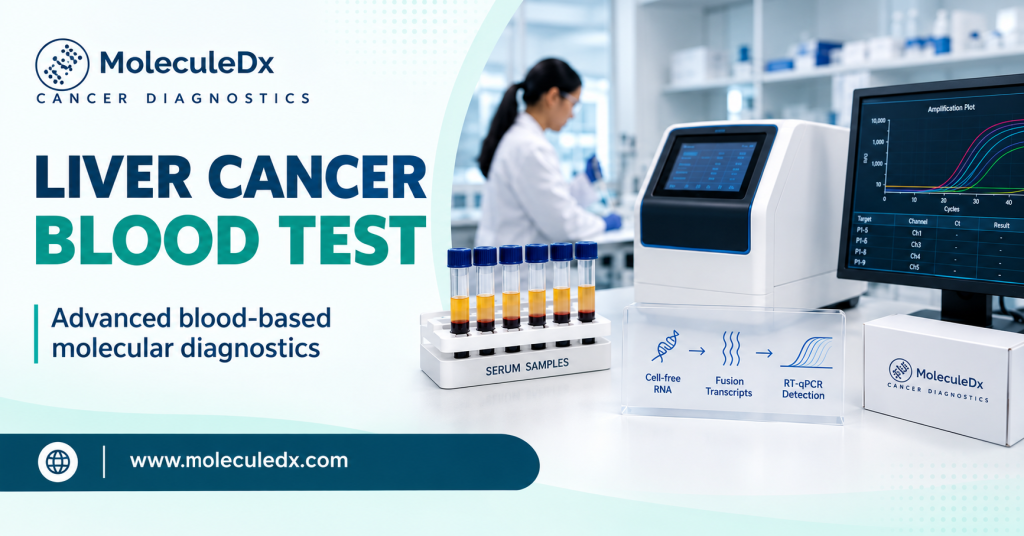
Molecular blood-based testing — a newer generation of HCC blood tests — goes beyond AFP by analysing cancer-specific molecular signals such as RNA fusion transcripts. These are abnormal molecules produced when chromosomal rearrangements occur in cancer cells. Because they are cancer-specific rather than general liver stress indicators, they can detect HCC in patients that AFP and ultrasound miss.
Strengths of blood-based HCC testing:
- No imaging equipment or specialist operator required
- Can be performed at home via certified phlebotomist
- Detects molecular signals before a visible lesion may appear on imaging
- Not affected by obesity, cirrhosis texture, or operator variability
- Can detect HCC in patients with completely normal AFP values
- Results available within 24 hours
- Accessible across all 50 US states
Limitations of Each Approach
Understanding the limitations of both methods is as important as understanding their strengths.
Ultrasound limitations: In patients with advanced cirrhosis, the liver surface becomes nodular and irregular — making it significantly harder to distinguish a small tumour from cirrhotic tissue on imaging. Studies show ultrasound sensitivity drops to as low as 45 percent in patients with liver cirrhosis and obesity combined. This is a serious problem because cirrhosis is the single strongest risk factor for HCC — meaning ultrasound performs worst in the very patients who need it most.
Blood test limitations: No blood test currently in clinical use can diagnose liver cancer on its own. A blood test result — whether AFP or a molecular test — must always be followed up with imaging if elevated or abnormal. Blood tests identify patients who need further investigation. They do not replace CT, MRI, or biopsy in the diagnostic pathway.
The combined picture: This is why current guidelines from the American Association for the Study of Liver Diseases recommend AFP combined with ultrasound rather than either alone. The two methods complement each other — ultrasound provides structural information, blood markers provide molecular information. Used together under physician guidance, they create a more complete surveillance picture than either provides independently.
How MoleculeDx May Fit Into Screening
MoleculeDx offers Fusion-detect™ — a blood-based HCC screening test that moves beyond AFP by analysing nine specific RNA fusion transcripts using a machine-learning algorithm developed from NCI-funded research at the University of Pittsburgh School of Medicine.
In clinical research, Fusion-detect™ achieved up to 95 percent accuracy in detecting HCC — compared to approximately 63 percent for ultrasound in real-world settings and approximately 52 percent for standard AFP testing. Critically, Fusion-detect™ detects HCC in patients with completely normal AFP values — the group where conventional blood and imaging surveillance most consistently fails.
For high-risk patients who face barriers to regular imaging — due to mobility, access, cost, or the logistical demands of repeat clinic visits — Fusion-detect™ offers an accessible, at-home option that delivers molecular-level HCC screening without leaving the house.
Fusion-detect™ at a glance:
- 95% HCC detection accuracy
- Detects HCC missed by both AFP and ultrasound
- At-home blood draw via certified phlebotomist
- Results within 24 hours
- Available across all 50 US states
- Walk-in available at all UPMC locations
- $160 for at-home collection
Fusion-detect™ is a screening support tool, not a diagnostic service. Results should always be reviewed with a qualified healthcare provider as part of a broader HCC surveillance plan. It is not a replacement for ultrasound — it is a complementary layer of detection that addresses the molecular gap ultrasound cannot fill.
Questions to Ask Your Doctor
When discussing HCC screening with your physician, these questions help frame the HCC blood test vs ultrasound decision for your specific situation:
- Given my risk profile, is ultrasound alone sufficient or should I also have blood-based testing?
- How reliable is ultrasound for detecting early HCC in someone with my liver condition?
- Is AFP the only blood marker being measured, or are molecular tests available?
- Would adding a blood-based molecular test to my current surveillance plan improve my early detection odds?
- How often should I be screened given my specific risk factors?
Frequently Asked Questions
Is a blood test or ultrasound better for liver cancer screening? Neither is definitively better — they measure different things and work best in combination. Ultrasound provides structural liver imaging but has real-world sensitivity of only 45 to 65 percent for early HCC. Blood tests like Fusion-detect™ analyse molecular markers and can detect HCC in patients ultrasound misses. Current guidelines recommend both approaches together under physician guidance for high-risk patients.
Can an ultrasound miss liver cancer? Yes. Ultrasound misses early-stage HCC in a significant proportion of cases — particularly in patients with obesity, advanced cirrhosis, or fatty liver disease. Studies show sensitivity as low as 45 percent in these populations. This is one of the primary reasons blood-based molecular testing has emerged as a complementary surveillance tool.
Can a blood test detect liver cancer ultrasound missed? Yes — this is one of the key advantages of molecular blood-based testing. Fusion-detect™ analyses RNA fusion transcripts — cancer-specific molecular signals — that are present in the bloodstream independently of whether a lesion is visible on imaging. It has been shown to detect HCC in patients with completely normal AFP levels and in cases where imaging surveillance has not yet identified a visible abnormality.
Do I need both a blood test and ultrasound? For most high-risk patients, a combination approach provides the most comprehensive surveillance. Blood-based testing adds molecular detection sensitivity, while ultrasound adds structural imaging information. Your physician is best placed to advise on the right combination and frequency for your individual risk profile.
Compare Your Current Screening Approach
If you are at high risk for HCC and want to understand whether blood-based molecular screening could add accuracy to your current surveillance plan, check your eligibility for MoleculeDx Fusion-detect and book your test
Contact MoleculeDx
Email: info@moleculedx.com Phone: +1 412 385 2581