What to Expect From a Liver Cancer Blood Test: From Blood Collection to Results
Blog What to Expect From a Liver Cancer Blood Test: From Blood…

Here is a question thousands of Americans with chronic liver disease type into Google every month — and the answer matters more than most people realise.
If you have cirrhosis, hepatitis B or C, or fatty liver disease, your risk of developing hepatocellular carcinoma (HCC) is significantly elevated. You may have been told to get screened. You may have wondered whether something as simple as a blood test could catch it. And you may have received conflicting answers depending on who you asked.
So — can liver cancer be detected by a blood test? The honest answer is: yes, blood tests can play an important role in liver cancer screening — but the type of blood test matters enormously, and no blood test alone confirms a diagnosis. Here is what you need to know.
A blood test cannot diagnose liver cancer on its own. Diagnosis requires imaging — typically contrast-enhanced CT or MRI — and in some cases a biopsy. However, blood tests can detect biological signals associated with liver cancer that prompt further clinical investigation.
When used correctly as part of a physician-guided surveillance plan, a liver cancer blood test can identify patients who need closer investigation — catching HCC at Stage I or Stage II, when survival rates can reach up to 90 percent, rather than after symptoms appear when outcomes are significantly worse.
The key question is not whether a blood test can help. It is which blood test — and how it fits into a broader screening plan.
Blood tests used in liver cancer screening look for specific biological signals that may indicate the presence of HCC or elevated risk. These signals fall into two main categories.
Protein markers — The most well-known is alpha-fetoprotein (AFP), a protein produced by the liver that is often elevated in patients with hepatocellular carcinoma. AFP has been used as a liver cancer blood test marker since the 1970s and remains part of many standard surveillance protocols.
Molecular markers — A newer generation of blood tests analyses cancer-specific molecular signals such as RNA fusion transcripts — abnormal molecules released into the bloodstream when chromosomal changes occur in cancer cells. These tests look at fundamentally different biological signals than AFP and can detect HCC in patients whose AFP levels are entirely normal.
Both types of blood test provide information that, combined with clinical context and physician guidance, can support earlier detection conversations and follow-up decisions.

This is the part that most patients need to hear clearly.
A blood test result — whether AFP or any other marker — cannot confirm a liver cancer diagnosis on its own. An elevated AFP level may be caused by other liver conditions including cirrhosis, hepatitis, and non-cancerous liver tumours. A normal AFP level does not rule out liver cancer. Imaging is always required to investigate a concern raised by a blood test result.
According to the American Association for the Study of Liver Diseases, blood-based testing is most valuable as part of a structured surveillance programme that includes regular imaging — not as a standalone replacement for it.
The purpose of a liver cancer blood test is not to replace clinical evaluation. It is to add a layer of detection sensitivity that helps identify patients who need further investigation — especially those who might be missed by AFP or ultrasound alone.
The AFP test is the most widely used liver cancer blood test in clinical practice today. It is inexpensive, widely available, and has been part of HCC surveillance guidelines for decades.
Its critical limitation is accuracy. AFP detects liver cancer in approximately 50 to 60 percent of cases. Studies consistently show that 15 to 30 percent of HCC patients have completely normal AFP values throughout their entire disease course. When a test designed to detect cancer shows normal results in a cancer patient, the consequences are severe — detection is delayed, treatment options narrow, and survival rates fall.
The National Cancer Institute has acknowledged this gap and funded research specifically aimed at developing more accurate blood-based alternatives. That research is the foundation of the MoleculeDx approach.
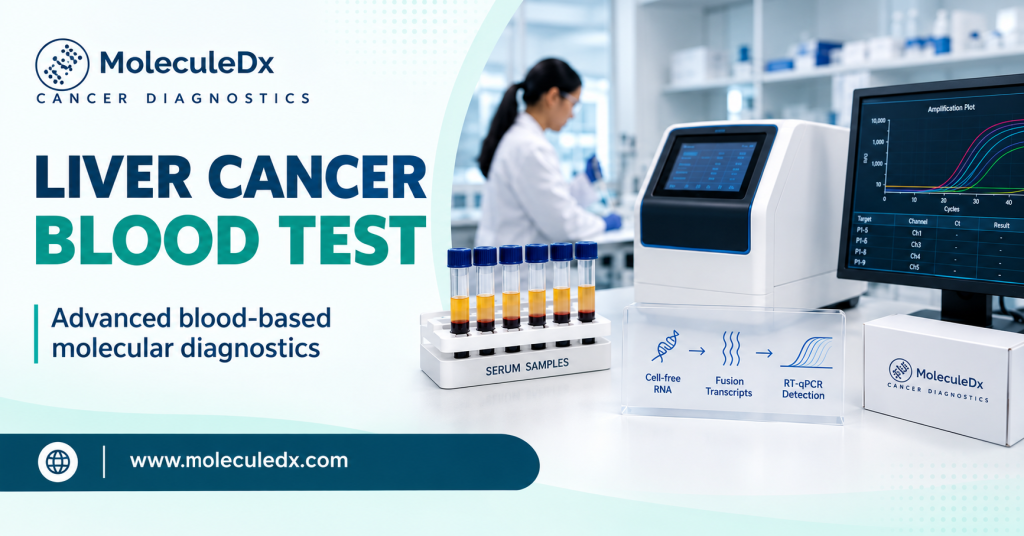
MoleculeDx offers Fusion-detect, a blood-based HCC screening test built on NCI-funded research at the University of Pittsburgh School of Medicine.
Rather than measuring AFP, Fusion-detect™ identifies nine specific RNA fusion transcripts — abnormal molecular signals produced by liver cancer cells and released into the bloodstream. A machine-learning algorithm analyses these markers to produce a high or low risk result. In research published in the American Journal of Pathology, this approach achieved up to 95 percent accuracy in detecting hepatocellular carcinoma — including in patients with completely normal AFP levels.
This matters because AFP regularly fails the exact patients who need it most — those with cirrhosis, hepatitis C, or NAFLD whose tumours never produce elevated AFP. Fusion-detect™ looks at a completely different biological signal, which is why it detects cancers AFP misses.
Key facts about Fusion-detect™:
Fusion-detect™ is a screening support tool. Results should always be reviewed with a qualified healthcare provider as part of a broader surveillance plan.
If any of the following apply to you, speak with your physician about whether a liver cancer blood test should be part of your surveillance plan:
Early action is always better than waiting for symptoms. Liver cancer rarely produces symptoms in its early stages. By the time symptoms appear, the window for curative treatment is often already narrowing.
1.Can a blood test diagnose liver cancer?
Ans : No. A blood test cannot diagnose liver cancer on its own. Blood tests such as AFP and Fusion-detect™ identify biological signals associated with HCC and flag patients for further investigation. Diagnosis requires imaging — contrast-enhanced CT or MRI — and sometimes biopsy. Blood-based screening is most effective as part of a physician-guided surveillance plan, not as a standalone diagnostic tool.
2.What is AFP and how reliable is it for liver cancer detection?
Ans: AFP stands for alpha-fetoprotein — a protein the liver produces that is often elevated in HCC patients. It has been used as a liver cancer blood test marker since the 1970s. However, AFP misses liver cancer in up to 40 to 50 percent of cases and produces false negatives in 15 to 30 percent of HCC patients who have normal AFP throughout their disease. AFP alone is no longer recommended as a standalone surveillance tool by major liver disease guidelines.
3.Do I still need imaging if my blood test result is normal?
Ans: Yes. A normal blood test result does not rule out liver cancer, particularly if you remain in a high-risk category due to cirrhosis, hepatitis, or another liver condition. Your physician will advise on the appropriate imaging schedule based on your individual risk profile. Blood-based testing is a supplement to — not a replacement for — structured imaging surveillance.
4.Who should consider blood-based liver cancer screening?
Ans: Anyone with elevated HCC risk should discuss blood-based screening with their physician. This includes patients with liver cirrhosis, chronic hepatitis B or C, NAFLD or NASH, alcoholic liver disease, or type 2 diabetes with liver involvement. For high-risk patients not currently in a regular surveillance programme, a liver cancer blood test is a practical and accessible starting point.
Can liver cancer be detected by a blood test? Yes — with the right test, interpreted by the right physician, as part of the right plan.
If you are high-risk and want to understand your blood-based screening options, check your eligibility for MoleculeDx Fusion-detect and book your test
Blog What to Expect From a Liver Cancer Blood Test: From Blood…

Blog Liver Cancer Blood Markers: What Do They Tell Us? Blood tests…

Blog 5 Benefits of Regular Liver Cancer Surveillance for People at High…