What to Expect From a Liver Cancer Blood Test: From Blood Collection to Results
Blog What to Expect From a Liver Cancer Blood Test: From Blood…

Cirrhosis is one of the most important risk factors for hepatocellular carcinoma. People living with cirrhosis should discuss liver cancer screening with a healthcare professional and understand which tools may be appropriate for their situation.
Cirrhosis is the advanced scarring of liver tissue caused by long-term damage. When healthy liver cells are repeatedly injured — by hepatitis B, hepatitis C, alcohol, fatty liver disease, or other causes — the body replaces them with scar tissue. Over time, this structural damage disrupts normal liver function and creates an environment where abnormal cell growth becomes significantly more likely.
People with cirrhosis have a 2 to 4 percent annual risk of developing hepatocellular carcinoma (HCC). Over a lifetime, studies estimate that up to 30 percent of people with cirrhosis will develop liver cancer. This is not a small risk. It is one of the highest cancer risk elevations associated with any single chronic condition.
The underlying cause of cirrhosis also matters. Cirrhosis caused by chronic hepatitis C, chronic hepatitis B, non-alcoholic steatohepatitis (NASH), or alcoholic liver disease each carries specific HCC risk profiles. However, the presence of cirrhosis itself — regardless of cause — is considered sufficient grounds for discussing regular liver cancer screening with a physician.
Not every person with liver scarring has the same risk level, but the following groups are most commonly recommended for structured HCC surveillance:
Current guidelines from the American Association for the Study of Liver Diseases (AASLD) recommend HCC surveillance every six months for patients with cirrhosis. If you have cirrhosis and are not currently enrolled in a structured screening program, that is the conversation to start with your hepatologist or gastroenterologist.
Abdominal ultrasound is the most widely used surveillance tool. It is non-invasive, broadly available, and recommended by major liver disease guidelines. However, its sensitivity for detecting early-stage HCC in cirrhosis patients is limited — ranging from 45 to 65 percent in real-world settings. Advanced cirrhosis and obesity further reduce image quality and detection accuracy.
AFP blood test measures alpha-fetoprotein, a protein associated with liver cancer. AFP is typically performed alongside ultrasound every six months. Its key limitation is accuracy — AFP misses liver cancer in up to 40 to 50 percent of cases. Between 15 and 30 percent of HCC patients have entirely normal AFP values throughout their disease, meaning a normal AFP result does not rule out cancer.
Contrast-enhanced CT or MRI is used for follow-up after an abnormal ultrasound or elevated AFP, rather than as a routine surveillance tool. These imaging methods offer high-resolution assessment of liver lesions but involve higher cost and, in the case of CT, radiation exposure.
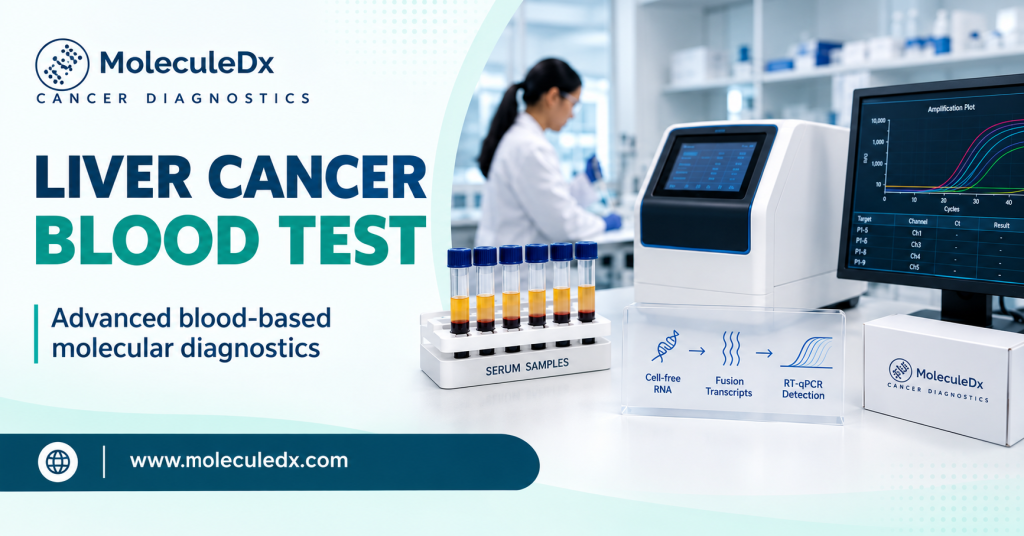
Blood-based molecular testing analyzes cancer-specific molecular markers in the bloodstream — such as fusion transcripts or methylation signals — that are distinct from AFP. These tests are designed to detect HCC in patients who would be missed by standard AFP testing, including cirrhosis patients with normal AFP values.
MoleculeDx offers Fusion-detect, a blood-based HCC screening test developed from research funded by the National Cancer Institute at the University of Pittsburgh School of Medicine.
The test detects nine specific fusion transcripts — abnormal RNA molecules released into the bloodstream by liver cancer cells. A machine-learning algorithm analyzes these markers and produces a high or low risk result. In NCI-supported research published in the American Journal of Pathology, this approach achieved up to 95 percent accuracy in detecting HCC — including in patients with completely normal AFP levels.
For cirrhosis patients specifically, this matters because AFP regularly underperforms in exactly this population. Fusion-detect™ looks at a completely different biological signal, which is why it can detect cancers AFP misses.
About the test:
MoleculeDx is a screening support tool, not a diagnostic service. Results should always be reviewed with a qualified healthcare provider.
This point deserves emphasis. Early-stage HCC rarely produces symptoms. Waiting for abdominal pain, unexplained weight loss, jaundice, or fatigue before investigating means waiting until the cancer has very likely progressed.
At Stage I or II, liver cancer survival rates can reach 90 percent. At Stage III or IV, median survival is under 12 months. The gap between those two outcomes is almost entirely determined by when the cancer is found — not how aggressively it is treated after the fact.
For people living with cirrhosis, proactive screening on a regular schedule is not an overcaution. It is the medically appropriate response to a documented, significant risk.
If you have cirrhosis and want to explore whether blood-based HCC screening support is available for you, visit moleculedx.com/for-patients/ to check eligibility and review collection options.
At-home collection is available nationwide through Portamedic and Travalab. Walk-in collection is available at all UPMC locations. Results are returned within 24 hours.
Discuss your result — and your overall HCC surveillance plan — with your hepatologist or primary care physician.
Does cirrhosis always lead to liver cancer? No. Not every person with cirrhosis will develop HCC. However, the annual risk is estimated at 2 to 4 percent, and cumulative lifetime risk can reach up to 30 percent depending on the underlying cause and disease progression. This elevated risk is the reason structured surveillance is recommended.
How often should people with cirrhosis discuss screening? AASLD guidelines recommend HCC surveillance every six months for cirrhosis patients. This typically involves ultrasound with or without AFP testing. Blood-based tests like MoleculeDx can be discussed with your physician as a supplementary option.
Can I take a blood-based screening test from home? Yes. MoleculeDx Fusion-detect™ offers at-home blood collection through certified phlebotomy partners available across all 50 US states. A trained phlebotomist visits your location, collects the sample, and results are returned within 24 hours.
What should I do after an abnormal result? An elevated result from any HCC screening test is not a diagnosis. It is a signal that warrants clinical follow-up. Your physician will typically recommend contrast-enhanced CT or MRI imaging to investigate further. Early-stage findings identified through this process are significantly more treatable than cancer discovered after symptoms appear.
If you have cirrhosis, you are in a high-risk group where proactive liver cancer screening can make a measurable difference in outcomes.
Check your eligibility at moleculedx.com/for-patients/ and speak with your healthcare professional about building a regular HCC surveillance plan that works for your situation.
connect with us : facebook , Instagram
Blog What to Expect From a Liver Cancer Blood Test: From Blood…

Blog Liver Cancer Blood Markers: What Do They Tell Us? Blood tests…
Blog 5 Benefits of Regular Liver Cancer Surveillance for People at High…