Liver cancer can develop without obvious symptoms, making regular surveillance particularly important for people at increased risk.
Hepatocellular carcinoma (HCC), the most common form of primary liver cancer, frequently occurs in people with chronic liver disease, including cirrhosis and chronic hepatitis B or C.
Blood testing can provide useful information about liver health and cancer-associated biological signals. Advances in molecular diagnostics are also making it possible to examine molecular changes associated with cancer through a blood sample.
For patients considering the MoleculeDx Liver Cancer Fusion Predictor, understanding how testing works—from arranging a blood draw to receiving results—can help make the process easier to navigate.
Who Should Consider Liver Cancer Blood Testing?
Not everyone has the same risk of developing HCC.
People who may benefit from discussing liver cancer surveillance with their healthcare providers include those with:
- Cirrhosis caused by chronic liver disease.
- Chronic hepatitis B infection.
- Chronic hepatitis C infection, particularly when advanced fibrosis or cirrhosis is present.
- Metabolic dysfunction-associated steatohepatitis (MASH) or alcohol-associated liver disease, especially when cirrhosis has developed.
- Other medical conditions associated with increased HCC risk.
Having one of these risk factors does not automatically mean that a particular blood test is necessary.
The appropriate surveillance strategy depends on the patient’s medical history, underlying liver condition, and individual risk profile.
For many eligible high-risk patients, clinical guidelines recommend regular HCC surveillance, commonly at approximately six-month intervals.
What Is the Liver Cancer Fusion Predictor?
Traditional liver cancer blood testing frequently involves measuring alpha-fetoprotein (AFP), a protein that can become elevated in some patients with HCC.
However, AFP may remain normal even when liver cancer is present.
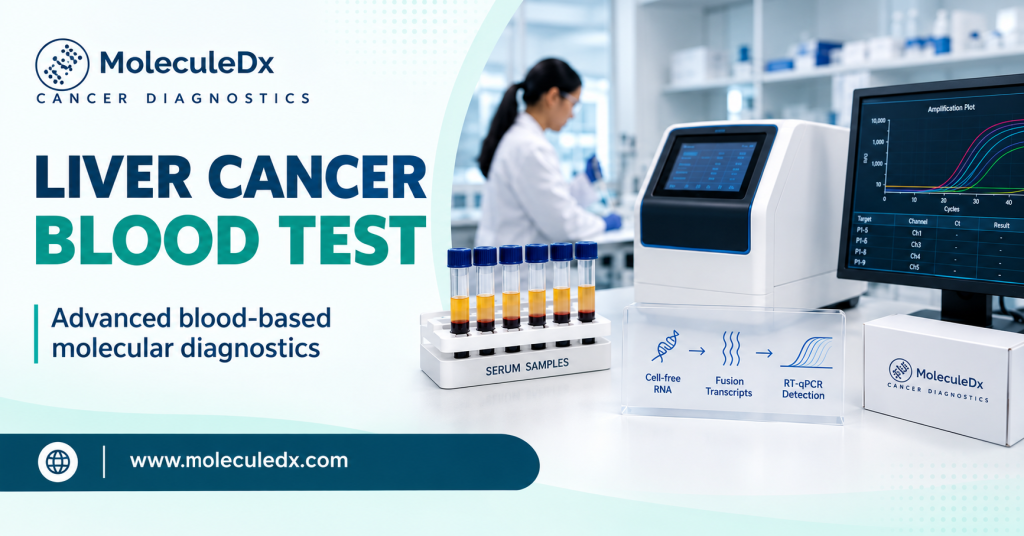
The MoleculeDx Liver Cancer Fusion Predictor takes a different molecular approach by analyzing cancer-associated fusion-transcript signals circulating in blood.
Fusion transcripts are RNA molecules produced when genetic rearrangements join portions of two different genes.
Research underlying MoleculeDx technology has demonstrated that selected fusion transcripts can be detected as cell-free RNA in serum from patients with HCC.
Rather than relying on a single molecular marker, the Liver Cancer Fusion Predictor evaluates multiple fusion-transcript signals using Fusion-detect™ technology and computational analysis.
This provides molecular information that is biologically different from conventional protein biomarkers.
How Do Patients Arrange a Blood Draw?
The MoleculeDx testing process is designed around a standard blood collection procedure.
Patients can begin by visiting the MoleculeDx website to review testing information and initiate an order.
For eligible patients, blood collection can be arranged through a qualified mobile phlebotomy service, subject to service availability.
A trained phlebotomist coordinates the appointment and performs the blood draw at the arranged location.
This approach can reduce the need to travel to a specialized medical center solely for specimen collection.
Patients should follow the collection instructions provided with their order and confirm any preparation requirements before the appointment.
What Happens During Blood Collection?
Blood collection is generally a straightforward procedure.
The phlebotomist verifies the patient’s identity, prepares the collection materials, and obtains a blood sample from a vein, usually in the arm.
The sample is collected into an appropriate tube for laboratory processing.
After collection, the specimen is labeled, packaged, and transported according to the laboratory’s handling requirements.
Proper specimen collection and transportation are important because molecular testing depends on maintaining the integrity of the material being analyzed.
What Happens After the Sample Reaches the Laboratory?
Once the specimen arrives at the MoleculeDx laboratory, it undergoes the necessary processing and analytical procedures.
The testing process focuses on detecting selected cancer-associated fusion transcripts in serum.
RNA is extracted from the specimen and analyzed using molecular amplification methods, including reverse-transcription quantitative polymerase chain reaction (RT-qPCR).
This technique allows the laboratory to measure specific RNA sequences associated with the selected fusion transcripts.
The resulting molecular measurements are then evaluated computationally.
Because different tumors may express different fusion transcripts, the analysis considers multiple molecular signals rather than depending entirely on one marker.
The testing approach is based on published research investigating circulating fusion transcripts in HCC.
What Do the Results Mean?
The Liver Cancer Fusion Predictor provides a categorical result based on the molecular signals evaluated.
A positive result indicates that the test has identified a pattern of molecular signals associated with HCC.
This does not, by itself, establish a diagnosis of liver cancer. A healthcare professional should interpret the result alongside the patient’s risk factors, medical history, and other clinical findings.
Additional diagnostic evaluation, including liver imaging, may be appropriate.
A negative result indicates that the test did not identify the specified molecular pattern according to its analytical criteria.
However, a negative result does not completely exclude HCC.
Patients who remain at increased risk should continue appropriate surveillance according to their healthcare provider’s recommendations.
How Are Results Delivered?
Following laboratory analysis and review, test results are made available through MoleculeDx’s secure reporting process.
Patients and their ordering healthcare providers can review the findings and determine whether additional evaluation is appropriate.
The time required for reporting can vary depending on specimen transportation, laboratory processing, and other operational factors.
Patients should consult their order information for applicable reporting arrangements.
What Happens After a Positive Result?
A positive molecular screening result is an indication that further clinical assessment may be warranted.
The healthcare provider may review the patient’s underlying liver condition, previous imaging studies, laboratory results, and other relevant clinical information.
Depending on the findings, additional diagnostic imaging, such as contrast-enhanced CT or MRI, may be recommended.
The purpose of follow-up is to determine whether the molecular result corresponds to clinically significant disease.
A blood-based molecular result should therefore be considered part of the broader clinical evaluation rather than a stand-alone diagnosis.
Why Is Ongoing Liver Cancer Surveillance Important?
Liver cancer surveillance is not necessarily a one-time event.
For people who remain at increased risk, regular monitoring provides opportunities to identify suspicious changes before symptoms appear.
Surveillance can involve imaging, established blood biomarkers, and other assessments selected by the healthcare provider.
Emerging molecular approaches, including fusion-transcript analysis, are being investigated as additional sources of biological information.
Different testing methods provide different information. The goal is to use these findings appropriately to support timely clinical evaluation.
Making Liver Cancer Blood Testing More Accessible
Advances in molecular diagnostics are expanding the types of cancer-associated signals that can be examined in blood.
MoleculeDx’s Liver Cancer Fusion Predictor applies research on circulating fusion transcripts to a blood-based testing approach.
By combining molecular analysis with an accessible blood collection process, MoleculeDx aims to make cancer-associated molecular information more readily available to patients and healthcare providers.
Understanding the testing process—from ordering and blood collection to laboratory analysis and clinical interpretation—can help patients make more informed decisions about their liver health.
For people with cirrhosis, chronic hepatitis B or C, or other significant HCC risk factors, the first step is to discuss an appropriate surveillance strategy with a qualified healthcare professional.