Hepatocellular carcinoma (HCC), the most common form of primary liver cancer, often develops in people with underlying liver disease. One of the challenges of HCC is that early-stage cancer may cause few or no noticeable symptoms.
For people at increased risk, regular liver cancer surveillance provides an opportunity to identify suspicious changes before symptoms appear, when potentially curative treatment options may still be available.
Three particularly important factors in assessing HCC risk are chronic viral hepatitis, cirrhosis, and family history of liver cancer. Understanding how these conditions affect risk can help patients and healthcare providers determine whether ongoing surveillance is appropriate.
What Is Liver Cancer Screening?
Liver cancer screening refers to testing for cancer in people who do not have symptoms. For patients already known to be at increased risk, healthcare professionals commonly use the term HCC surveillance, meaning regular monitoring over time.
For many eligible high-risk patients, clinical guidelines recommend liver ultrasound, often combined with alpha-fetoprotein (AFP) blood testing, at approximately six-month intervals.
The appropriate surveillance strategy depends on the patient’s underlying liver condition, risk factors, and clinical circumstances.
Surveillance is different from diagnosis. An abnormal screening result may indicate the need for further evaluation, including contrast-enhanced CT or MRI, but does not by itself establish that HCC is present.
How Does Chronic Hepatitis B Increase Liver Cancer Risk?
Chronic hepatitis B virus (HBV) infection is an important risk factor for HCC.
HBV can cause persistent liver inflammation and injury, potentially leading to fibrosis and cirrhosis. However, an important feature of hepatitis B is that HCC can develop even in patients who have not developed cirrhosis.
This distinguishes chronic HBV infection from many other chronic liver diseases in which HCC risk is most strongly associated with advanced fibrosis or cirrhosis.
The risk of HCC among people with chronic hepatitis B varies according to factors such as age, sex, family history, viral activity, liver fibrosis, and other clinical characteristics.
Certain groups of patients with chronic HBV may benefit from regular HCC surveillance even without cirrhosis.
Antiviral treatment can reduce the risk of liver cancer, but it does not eliminate that risk entirely. Patients receiving successful HBV treatment may therefore still require ongoing surveillance, depending on their individual risk profile.
Hepatitis C and the Risk of Liver Cancer:
Chronic hepatitis C virus (HCV) infection can also cause progressive liver injury, fibrosis, and cirrhosis.
Over time, persistent liver inflammation and scarring increase the risk of developing HCC.
Modern direct-acting antiviral medications can cure hepatitis C infection in most treated patients. Successful treatment substantially reduces the risk of liver-related complications, including HCC.
However, patients who have already developed cirrhosis may remain at increased risk of HCC even after hepatitis C has been cured.
For these patients, continued liver cancer surveillance may remain important.
The need for surveillance after successful HCV treatment depends on the degree of liver fibrosis, the presence of cirrhosis, and other clinical factors.
Why Is Cirrhosis an Important Risk Factor?
Cirrhosis is advanced scarring of the liver caused by long-standing liver injury.
It can develop from several conditions, including:
- Chronic hepatitis B or hepatitis C infection.
- Alcohol-associated liver disease.
- Metabolic dysfunction-associated steatotic liver disease (MASLD), including metabolic dysfunction-associated steatohepatitis (MASH).
- Certain autoimmune, inherited, or other chronic liver diseases.
Cirrhosis changes the structure and function of the liver and creates an environment in which cancer may develop.
For many patients with cirrhosis, regular HCC surveillance is recommended because the risk of liver cancer is substantially higher than in people without advanced liver disease.
However, surveillance eligibility also depends on overall health, liver disease severity, and whether a patient could benefit from HCC-directed treatment if cancer were detected.
Having cirrhosis does not mean that liver cancer is present. It means that the patient’s liver condition may require closer monitoring.
How Does Family History Affect Liver Cancer Risk?
Family history can provide important information about an individual’s likelihood of developing HCC.
Having a first-degree relative—such as a parent, sibling, or child—with HCC is particularly relevant when evaluating patients with chronic hepatitis B.
Some individuals with chronic HBV and a family history of HCC may qualify for surveillance at an earlier age or under different risk criteria than patients without that history.
Family history should be considered alongside other factors, including age, sex, HBV status, liver fibrosis, and overall liver health.
A family history of liver cancer does not mean that someone will necessarily develop HCC. Nor does family history alone automatically establish a need for regular surveillance.
However, it is important information to share with a healthcare provider when discussing liver cancer risk.
What Tests Are Used for HCC Surveillance?
Liver ultrasound is a commonly recommended method for HCC surveillance because it is noninvasive and widely available.
AFP blood testing may also be used as part of the surveillance strategy.
However, both approaches have limitations.
Ultrasound sensitivity can be affected by obesity, advanced liver disease, and other patient-related factors. AFP may remain within the normal range in some patients who have HCC.
Therefore, a normal AFP result does not necessarily mean that liver cancer is absent.
When screening findings are concerning, healthcare professionals may recommend additional diagnostic imaging, such as contrast-enhanced CT or MRI.
Can Blood-Based Molecular Testing Provide Additional Information?
Advances in molecular diagnostics are creating opportunities to investigate cancer-associated signals that conventional protein biomarkers do not measure.
One emerging approach involves fusion transcripts.
Cancer cells can undergo chromosomal rearrangements that join portions of two different genes, creating fusion genes. When expressed, these rearranged genes can produce RNA molecules called fusion transcripts.
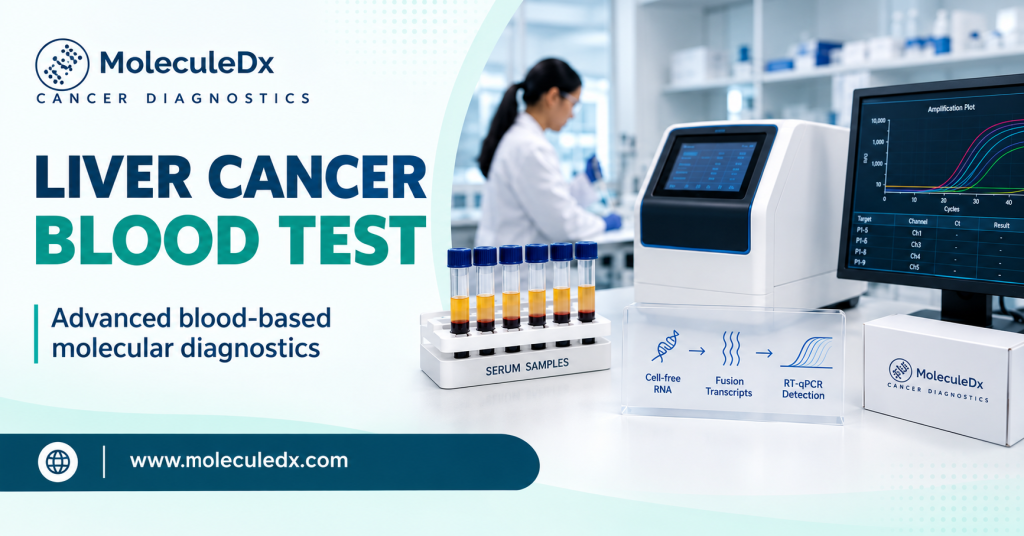
Research underlying MoleculeDx technology has demonstrated that selected cancer-associated fusion transcripts can be detected as circulating cell-free RNA in serum from patients with HCC.
Unlike AFP, which measures a protein concentration, fusion-transcript analysis examines RNA signals associated with cancer-related genomic rearrangements.
The MoleculeDx Liver Cancer Fusion Predictor applies Fusion-detect™ technology to analyze multiple cancer-associated fusion-transcript signals in blood.
This approach provides molecular information that is biologically different from conventional protein biomarkers.
Blood-based molecular testing should be interpreted alongside clinical information and appropriate imaging rather than being used as a stand-alone diagnosis of HCC.
Who Should Discuss Liver Cancer Surveillance With a Healthcare Provider?
People with chronic liver disease or other important HCC risk factors should discuss their individual risk with a qualified healthcare professional.
This is particularly relevant for people with cirrhosis, selected patients with chronic hepatitis B, and patients with hepatitis C–related cirrhosis, including those whose infection has been successfully treated.
Family history, metabolic liver disease, alcohol-associated liver disease, and other medical conditions may also influence an individual’s overall risk.
Important questions to discuss include:
- Do I have chronic hepatitis B or hepatitis C?
- Do I have liver fibrosis or cirrhosis?
- Does my family history increase my HCC risk?
- Should I undergo regular liver cancer surveillance?
- Which imaging and blood tests are appropriate for me?
- How frequently should surveillance be performed?
- What follow-up is needed if a screening result is abnormal?
Understanding Your Risk Is the First Step:
Hepatocellular carcinoma can develop without noticeable early symptoms, making surveillance particularly important for people at increased risk.
Chronic hepatitis B, chronic hepatitis C, cirrhosis, and family history can influence HCC risk in different ways. Understanding these differences helps patients and healthcare providers develop appropriate surveillance strategies.
Established imaging and blood biomarkers remain important, while emerging molecular approaches such as fusion-transcript analysis are providing additional ways to investigate cancer-associated signals.
The most important first step is knowing your risk and discussing an appropriate liver cancer surveillance plan with your healthcare provider.